On a long drive through western Poland, a weary couple is forced to witness an unusual performance of the work of the British pop star.
It takes about 45 minutes to drive from Poznań to our village, and a lot can happen in that time. Especially when you don’t have a car.
These drives make for an unusually close acquaintance with the Uber driver as you slip out of the city, the lights fall away, and it’s nothing but the quiet highway, the dark forest, and the stranger with the steering wheel – and your life – in his hands.
There was the stocky Ukrainian soldier, recently returned from the front, who passed back his phone for us to look through for photos of dead soldiers neatly arranged on the grass. The wiry Azerbaijani DJ who kept referring to the town of Murowana Goslina as Murowana Gasolina.
And then there was him. The strangest of them all. Kamil. We saw the Polish name on the app, which is now unusual. The car was clean on the outside, and smelled a little on the inside; not dirty or cigarette smoky, but something faintly pungent, organic. He was bald, pale, and dressed in shorts that ended halfway between his knees and the place on which he sat.
We’d taken an Uber because the night before, we’d been at a wedding. It was in a castle in Leszno, far on the other side of Poznań. The priest made jokes in the ornate church. The food washed over the table like a porcine waterfall. Bottles of vodka were passed out to guests like water at the finish line of a marathon.
The next morning, we needed a helping hand. Rather than taking yet another train, we decided to save an hour and splurge on a direct ride from Poznan to our city. This is not quite as extravagant as it sounds. Poland is no longer a cheap country, but Uber still pulls in imported labor from Ukraine and the rest of the former Soviet Union, and rates stay stubbornly low. The 30-kilometer journey normally costs about 120 Polish zloty, or about 35 dollars.
I often practice my Polish on these rides, but since Kamil had heard my wife and I speaking to each other in English, he enthusiastically followed. He asked a couple of perfunctory yet polite questions about the temperature in the car and made some remarks on the traffic, before getting to what, I soon realized, he had been working his way towards.
“Do you like karaoke?”
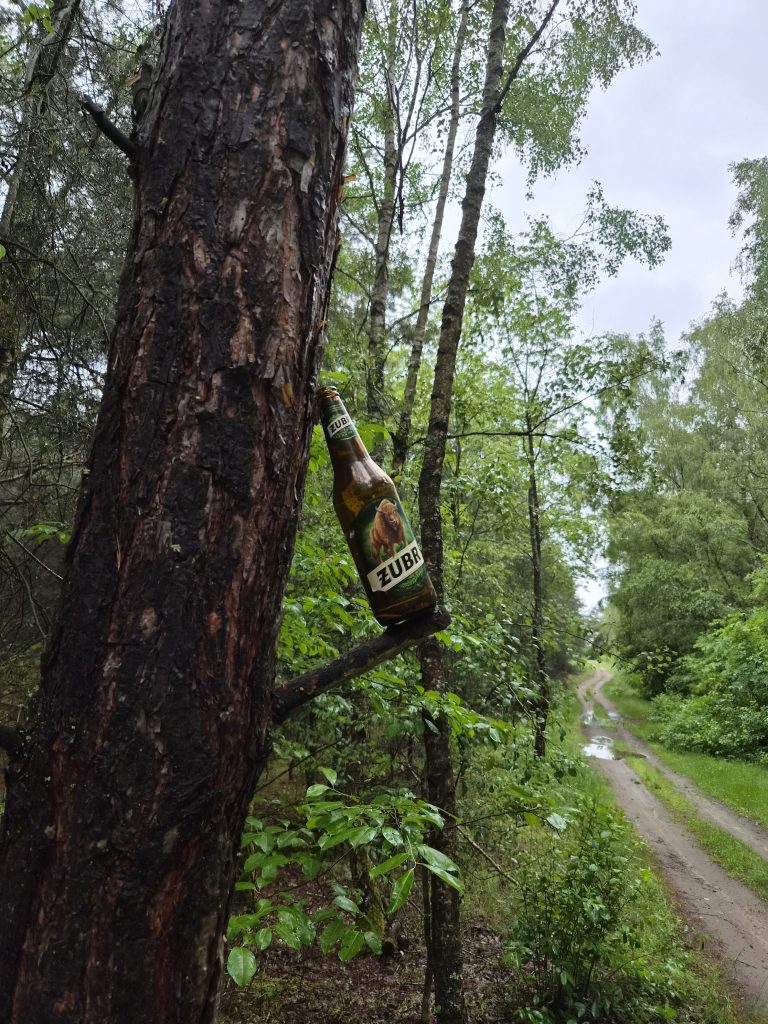
A traditional decoration on a rural backstreet.
If I could go back in time, I wouldn’t kill baby Hitler. I would simply tell myself to answer with a firm, “No.” I would tell him I hate karaoke. That it is an insult to all artists who work so hard to perfect their craft. The pastime of drunks, or egomaniacs, of the insane, making the public street their shower in which to sing with a voice that no one should hear.
But I didn’t say any of that. I smiled. (Fool!).
“Uh, sure.”
“Because I like. I have second job. Security guard. And in the nights when it’s not busy, I make karaoke. Do you want to listen?”
At this point, my wife buried herself under her cap and pretended to be asleep. Trapped now. To say no would be churlish. To say yes would invite torture.
“Uh, sure.” I said again.
“Because we have long drive.” He said, barely suppressing a grin. “I do not drink,” he said. Bad sign, I thought. “So on weekend also. I drink coffee. And I do karaoke.”
And he fidgeted with his phone, and a beat came on, and then… and then it was his voice.
“This is Harry Styles.”
A low croon. A high note. Something about strawberries. A beat that left him behind, a falsetto wail that left him sprawled on his face, but he didn’t notice, and charged on to the next verse. Strawberries again. I have no strong opinion on Harry Styles, but I must hold him partially responsible for the torture that followed.
We left the taxi forty minutes later on shaky legs, scarcely able to believe what had happened. It wasn’t all karaoke. Sometimes he let the radio play. But even then, he sang along, with the confidence and brio of an undiscovered genius simply waiting for the shoulder tap, the summons to greatness.
Perhaps he thought these two hungover foreigners (for my wife, wisely, did not reveal that she was Polish) were secret record producers? With one phone call, Simon Cowell would be in his Uber. James Corden would appoint him the successor to Carpool Karaoke. His dreams would come true.
Almost twenty years ago, I stood alone on a railway platform somewhere in the center of Australia, swaying underneath an oversized backpack. I got to chatting to a scholarly-looking man with frameless spectacles and an ironic, ingratiating smile. He told me he taught classes in the local prison system. “I like to have a captive audience,” he quipped.
And that was us. A captive audience. And what a gift we were.
What writer, after all, wouldn’t want to hold readers hostage? To force them to hear your poetry, to read your stories? To see their eyes riveted to each letter, to not let them free until they have absorbed every paragraph, every sentence, every word. And when the appropriate words of praise are uttered, then and only then would you generously unclick the door, and let them go home; if only to reflect on the greatness they have witnessed.
I do not drive a taxi, and I do not lecture in prisons. I must somehow attract an audience to read these words out of their own free will. Perhaps I’ll talk about Harry Styles. Because I hear he likes strawberries.