

An explorer seeking to document the world’s most remote and isolated cultures finds himself entering a mysterious land of voodoo magic and animism in the ancient African kingdoms of Benin.
My remote travels through Africa have revealed an ancient continent struggling to catch up with the modern world. To survive economically, many vanishing cultures have contracted with safari companies to present facsimiles of once sacred and secret ceremonies to tour groups. For some, this has been a painful experience. Once proud warrior nations, such as the Maasai and Zulu, now offer “cultural” villages that showcase what used to be.
I have tried to give these vanishing people some small public voice to tell the world that they exist before they are gone forever. When the last speaker of a language dies, an entire culture dies with him or her, leaving a gaping hole in the collective consciousness of humankind. In an oral society, that is, to quote an old African saying, “Like a library burning.”
It is this transition that has led me to leave the beaten path and find those isolated people who still cling to the old ways. Animism began in Africa and, over millennia, evolved into voodoo, which today permeates West Africa. Voodoo is a part of old Africa, and a contemporary way of life for millions. “Tourist” Africa gave me a need to see the old spear and loincloth people before they vanish forever.
Having made numerous expeditions to remote areas, I knew that the success of such ventures relies heavily on local guides. They are the unsung, anonymous heroes of adventure travel without whom no great expedition could succeed. And so, I found Noah in a sea of people at the Togo airport. I have often chosen a local guide from the throng of pushing and shoving hopefuls that assault a traveler the moment they exit a plane in Africa. Most of the time, it is a gut feeling, which is rarely wrong, and that is what I felt when Noah and I locked eyes. He stood in the back, smiling, as though he knew I would choose him, and I am glad that I did.
He was a bear of a man for a Togolese, with skin so black all I could see of him at night were his smiling white teeth. He was one of those guys with whom you want to have a beer and talk through the night. He spoke several languages thanks to his international clientele, and he grew up immersed in voodoo but was not an active participant. He viewed his work as a guide, as a higher role; that of an educator, walking a fine line between the secular and metaphysical worlds. He was exactly what I needed because to find old Africa, I must enter the world of voodoo.
After a pleasant two-day drive, we reached the Taneka region of Benin, a land that carries a palpable presence of a connection to ancestors and tradition. It was there in the early mist of animism that ancient peoples first worshipped the elements and documented those acts in carved stone. The oral histories of that act have been carried forward for some six thousand years, always evolving until it became voodoo. Its influence covers eleven West African nations, with more than five million practitioners in various incarnations. It is currently the state religion of Benin, and while it has no dogma, African voodoo remains among the oldest known belief systems on earth.

Together, as master and student, Noah and I entered this world on the sloping hills of the Atakora mountain range in Northwestern Benin.
On an elevated plateau, some eighty thousand Tangba people have shunned the outer world for centuries. They are not Indigenous but are three different ethnic groups who came together before recorded history in self-defense against African kings who once sold their own people to white slavers. The word Taneka has multiple meanings, from “warriors” to “stone people.” They are among the most ancient and isolated people on earth. They live by decree of a chosen king known as a Sawa, who is supported by holy men. Decisions regarding each village are made by a council in a sacred cave, and people wear animal parts as daily dress.
Taneka was the Africa I was seeking.
Pays Taneka is prehistoric. There was a primordial feel to the place that made me feel it would not be unusual to find some extinct beast. As we approached the first village, we were greeted by a young girl with animal horns on her head who smiled and continued on her way. The hazy smoke of wood fires compelled butterflies to dance, and the red clay earth hugged our boots, permeating everything we carried with fine dust. Massive Marula trees gave shade from the burning African sun, and we watched a milky ground fog burn away as people began to appear through the morning mist.
We saw an ancient, bare-breasted woman with leathery skin shelling peanuts in front of her hut. As we passed, she made a sign with her hand, as if blessing us. Several people approached and pointed to a low mud hut with a thatched roof, like many others, but bearing esoteric designs painted on the walls.
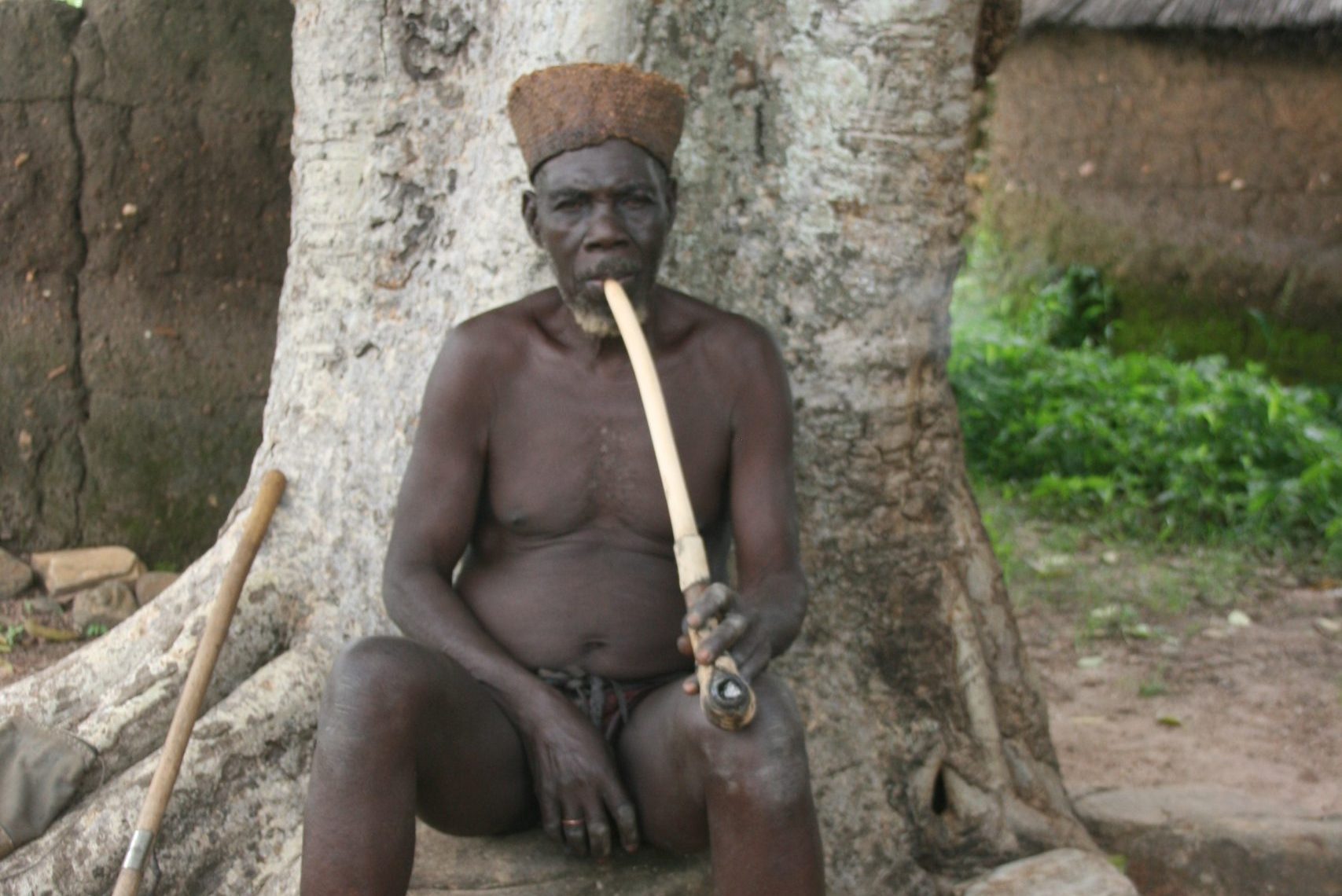
We were to pay our respects to the village headman, as they had no chiefs. He sat outside on the roots of a tree puffing on a long clay pipe that he passed to us. In many remote societies, this is a ritual of welcome, and to refuse could insult the host. Sometimes it is only tobacco, while others, it is a local ganja that can tear your head off. This was the latter. We sat mesmerized while the old man spread his arms as though embracing the entire land, while giving a lengthy monologue. Noah, though stoned, interpreted the history of the people as told by our host, and I felt embraced as though we were surrounded by our ancestors. When he finished, the elder stood and hugged me in welcome.
Taneka had yet to be discovered by the safari companies and usually hosted only solo trekkers. We were offered a hut, which we appreciated. Inside were low beds made of tree branches. And so, we settled in to merge with the land and the people.
Taneka had its own vibration unlike any I had visited in Africa. These elegant villages were different; they were alive! Besides scattered mud huts with thatched roofs, there were many “Spirit Houses” with doorways of giant mouths over which eye and nose holes were drilled, giving each structure its own unique face, intent on devouring any evil that might try to invade the home. Round clay fetishes of different sizes covered the earth in all directions, serving as “watchers” in case the wrong spirits should attempt an approach. People wore horns of their “spirit” animals to gain their power, and mothers placed animal bone amulets around their infants’ necks. One leathery gentleman wore a necklace of several chicken feet. The village walls were painted with esoteric designs; their meanings were lost in the mists of time. In the surrounding forests, animal bones called “gris gris” hung from trees as a warning to unwelcome spirits. I could physically sense a presence in this land.
Most of the women were bare-breasted and the men wore a tiny goat skin covering. Everyone carried themselves with a regal dignity. One man asked where I came from, and he had no clue when I mentioned my country. I pointed up at an airplane far above, and through Noah, he asked if a spirit had carried me there. He then asked if I had seen God while in the sky, and when I said no, he asked why I had gone there then. This was a precious insight into an ancient culture.
This was a land that lived and breathed its beliefs, where there was no separation between the everyday and spiritual worlds. Through Noah, I learned the concept of Loa: spirits that inhabit and animate everything, while each person has an inner essence known as Iwa. He explained that voodoo carried no dogma and had its own form in each distinct village and area.
At night, there was dancing, drumming, and storytelling, and I could not help but see similarities between Taneka and my own Catholic upbringing that I had abandoned years ago. Just like a Catholic Mass, the people of Taneka used costumes, music, and ceremony to bring their beliefs to life. While there was no one God or prophet, I could imagine the evolution of most major religious ceremonies from this simple belief system. It was these similarities to an earlier life that put me at such ease. Pays Taneka is the culmination of thousands of years of African animism and made me realize that man has always sought a higher power and a reason for our own existence.
One morning, after a hard rain, Noah drove me to an isolated clearing in the forest. There was a rising vapor of steam coming off the foliage like dancing spirits. I recall there being absolute silence, not even a bird song was evident. We approached a large rock formation that clearly had the shape of a giant lizard. It must have been twenty feet tall and fifty feet long, and it was covered with pictographs and petroglyphs. While much of the inscriptions had faded from centuries under the African sun, I could clearly make out a crescent moon, swirling sun, stars, and several people gathered below, all with their arms raised high as if invoking a deity. Noah told me that this was the site of the first voodoo ceremony, claimed through oral history from almost six thousand years ago. While there is no documentation to prove that claim, it was clearly a ceremonial site that had been in use for centuries, if not millennia.
Eventually, it was our time to go, and as we made our way down the hill, we were greeted by the headman, leaning on an intricately carved walking stick. He had come to give us his blessing, and he told Noah that the spirits “approved” me. With that, he placed a tiny leather voodoo pouch around my neck. Several other people came up and began to grab my hand or touch my arm. Noah said they were seeking my blessing since the spirits favored me. He told me to place my hand on their heads, so I did, feeling completely unworthy. Arriving back at our Land Rover, we found it covered with flowers. Once inside, the people ran their hands over the vehicle as we pulled slowly away.
On our final day together, I asked Noah if he knew what might be inside my pouch. He only gave me an enigmatic smile as he shook my hand goodbye.
While exploration is a search for answers, I believe there are things we mortals are simply not meant to know or understand. I had briefly entered the world of voodoo and found it inseparable from the land and the people, a quality I feel is lacking in my homeland.
To this day, years later, I have never opened my pouch.


